



Towing Your Vehicle Behind a Motorhome
Your vehicle can be towed behind a motorhome at legal highway speeds up to 65 mph (100 km/h). Do not exceed 65 mph (100 km/h).
Otherwise, severe transmission damage will occur. To avoid damage to the 4WD system, your vehicle must be towed with all four wheels on the ground (flat towing).
When purchasing a tow bar, make sure you select a reputable manufacturer and installer. Follow the manufacturer’s attachment instructions carefully.
Perform the following procedure every day immediately before you begin towing. Otherwise severe automatic transmission damage will occur.
Check the transmission fluid level. Do not overfill.
Start the engine.
Press on the brake pedal. Move the shift lever through all its positions.
Shift to D position and hold for 5 seconds, then to N. Let the engine run for 3minutes, then turn it off.
Release the parking brake.
Leave the ignition switch in the ACCESSORY (I) position so the steering wheel does not lock.
Make sure the radio and any items plugged into the accessory power sockets are turned off so you do not run down the battery.

The steering system can be damaged if the steering wheel is locked. Leave the ignition switch in the ACCESSORY (I) position, and make sure the steering wheel turns f reely bef ore you begin towing.
Extended Towing
If you tow more than 8 hours in one day, you should repeat the above procedure at least every 8 hours (when you stop for fuel, etc.)
Failure to f ollow the recommended instructions exactly will result in severe automatic transmission damage. If you cannot shif t the transmission or start the engine, your vehicle must be transported on a f lat-bed truck or trailer.
When towing your vehicle for long periods, remove the 7.5 A Accessory Radio fuse to reduce drain on battery.
This fuse is located in the interior fuse box and is shown as number 34 below.
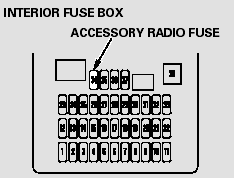
Only remove the fuse after you have performed the transmission shifting procedure, and the key is in the ACCESSORY (I) position. Store the fuse in an obvious location (center tray, coin pockets, etc) as a reminder to re-install the fuse before driving the vehicle.
Severe transmission damage will occur if the vehicle is shif ted f rom reverse to neutral and then towed with the drive wheels on the ground.
If you tow a CR-V behind a motorhome, the transmission fluid must be changed every 2 years or 30,000 miles (48,000 km), whichever comes first.
See also:
Changing the Front Wiper Blade Rubber
1. Lift the driver side wiper arm first, then the
passenger side.
2. Pry on the edge of the lock tab using a flattip
screwdriver to push it up.
- Wrap the flat-tip screwdriver with a cloth
to ...
Remote Transmitter Care
Replacing the Button Battery
If the indicator does not come on when the button is pressed, replace the battery.
Battery type: CR1616
1. Unscrew the cover with a small Phillipshead screwdriver. Pre ...
High-Mount Brake Light Bulb
When replacing, use the following bulb.
High-Mount Brake Light: 5 W
1. Remove the lens segment by prying on the edge using a flat-tip screwdriver.
- Wrap the flat-tip screwdriver with a clo ...