



Your Vehicle's Safety Features
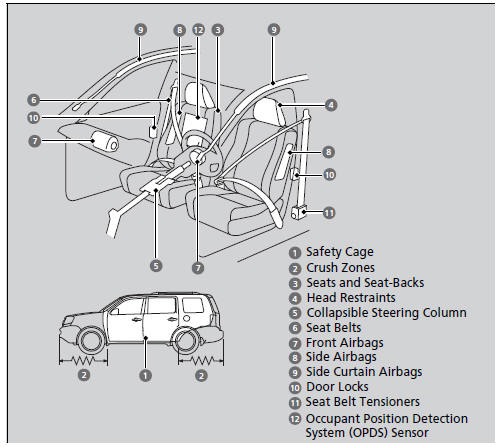
The following checklist will help you take an active role in protecting yourself and your passengers.
Your Vehicle's Safety Features
Your vehicle is equipped with many features that work together to help protect you and your passengers during a crash. Some features do not require any action on your part. These include a strong steel framework that forms a safety cage around the passenger compartment, front and rear crush zones, a collapsible steering column, and tensioners that tighten the front seat belts in a sufficient crash. However, you and your passengers cannot take full advantage of these features unless you remain seated in the correct position and always wear your seat belts. In fact, some safety features can contribute to injuries if they are not used properly.
See also:
Playing the AM/FM Radio
Auto Select
Use the auto select feature to scan both bands and store the strongest station
in each preset.
1. Press the SETUP button.
2. Rotate to select Auto Select,
then press .
3. ...
Refueling
Fuel recommendation: Unleaded gasoline with a pump octane number 87 or higher
required
Fuel tank capacity: 21 US gal (79.5 L)
1. Pull the fuel fill door release handle.
2. Turn the fuel fill cap ...
Maintenance Minder Messages on the Information Display
To switch the display, press the
(Select/Reset) knob.
...