



Safety of Larger Children
Protecting Larger Children
The following pages give instructions on how to check proper seat belt fit, what kind of booster seat to use if one is needed, and important precautions for a child who must sit in front.
Checking Seat Belt Fit
When a child is too big for a child seat, secure the child in a rear seat using the lap/ shoulder seat belt. Have the child sit upright and all the way back, then answer the following questions.
Checklist
Do the child's knees bend comfortably over the edge of the seat?
Does the shoulder belt cross between the child's neck and arm?
Is the lap part of the seat belt as low as possible, touching the child's thighs?
Is the lap part of the seat belt as low as possible, touching the child's thighs?
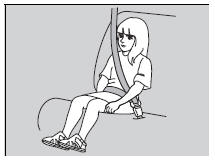
If you answer yes to all these questions, the child is ready to wear the lap/shoulder seat belt correctly. If you answer no to any question, the child needs to ride on a booster seat until the seat belt fits properly without a booster seat.
Safety of Larger Children
WARNING
Allowing a child age 12 or under to sit in front can result in injury or death if the passenger's front airbag inflates. If a larger child must ride in front, move the vehicle seat as far to the rear as possible, have the child sit up properly and wear the seat belt properly, using a booster seat if needed.
Booster Seats
If a lap/shoulder seat belt cannot be used properly, position the child in a booster seat in a rear seating position. For the child's safety, check that the child meets the booster seat manufacturer's recommendations.
Protecting Larger Children-Final Checks
Your vehicle has a rear seat where children can be properly restrained. If you ever have to carry a group of children, and a child must ride in front:
• Make sure you read and fully understand the instructions and safety information
in this manual. • Move the front passenger seat as far back as possible.
• Have the child sit upright and well back in the seat.
• Check that the seat belt is properly positioned so that the child is secure in
the seat.
Monitoring child passengers
We strongly recommend that you keep an eye on child passengers. Even older, more mature children sometimes need to be reminded to fasten their seat belts and sit up properly.
Booster Seats
When installing a booster seat, make sure to read the instructions that came with it, and install the seat accordingly. There are high- and low-type booster seats. Choose a booster seat that allows the child to wear the seat belt correctly. Some U.S. states and Canadian provinces and territories require children to use a booster seat until they reach a given age or weight (e.g. 6 years or 60 lbs). Be sure to check current laws in the state or province, or territory where you intend to drive.
See also:
If a Tire Goes Flat
Changing a Flat Tire
If a tire goes flat while driving, grasp the steering wheel firmly, and brake
gradually
to reduce speed. Then, stop in a safe place. Replace the flat tire with a
compact
sp ...
Recommended CDs
Use only high-quality CD-R or CD-RW discs labeled for audio use.
Use only CD-R or CD-RW discs on which the recordings are closed.
Play only standard round-shaped CDs.
CDs with MP3, WMA or AAC fil ...
Vehicle Stability Assist (VSA ), aka Electronic Stability Control (ESC), System
The vehicle stability assist (VSA) system helps to stabilize the vehicle during
cornering if the vehicle turns more or less than desired. It also assists you in
maintaining traction while accelera ...